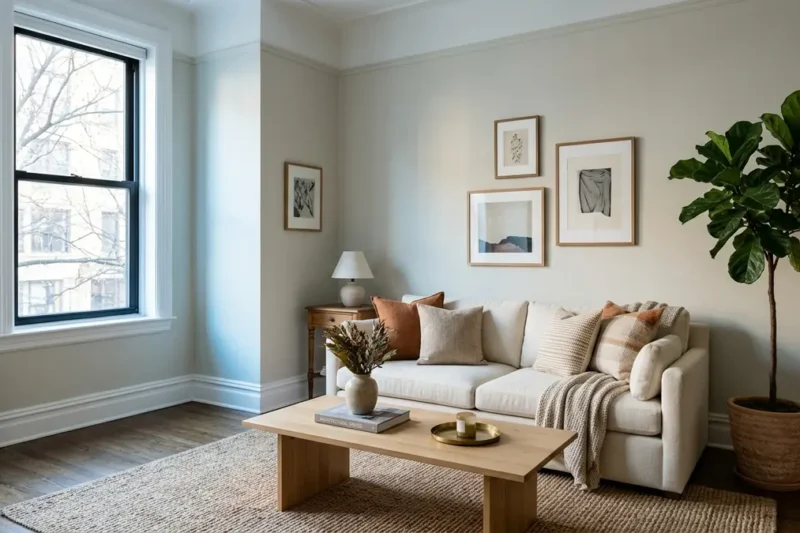
15 Narrow Hallway Decor Ideas That Feel Bigger

In this article
- Quick Facts
- All 15 Small Hallway Decor Ideas on a Budget at a Glance
- Paint & Color Tricks That Visually Widen a Hallway
- 1. Paint walls and ceiling the same light color — $35
- 2. Try the two-tone trick: darker below, light above — $45
- 3. Paint just the end wall dark to "shorten" the tunnel — $20
- 4. Paint a faux runner on the floor — $25
- Mirrors & Lighting: The Tunnel Breakers
- 5. Hang one large mirror at the end or opposite a doorway — $60
- 6. Add light fixtures every 8–10 feet — $20 each
- 7. Run an LED strip along the baseboard or a picture ledge — $15
- Walls That Work Hard
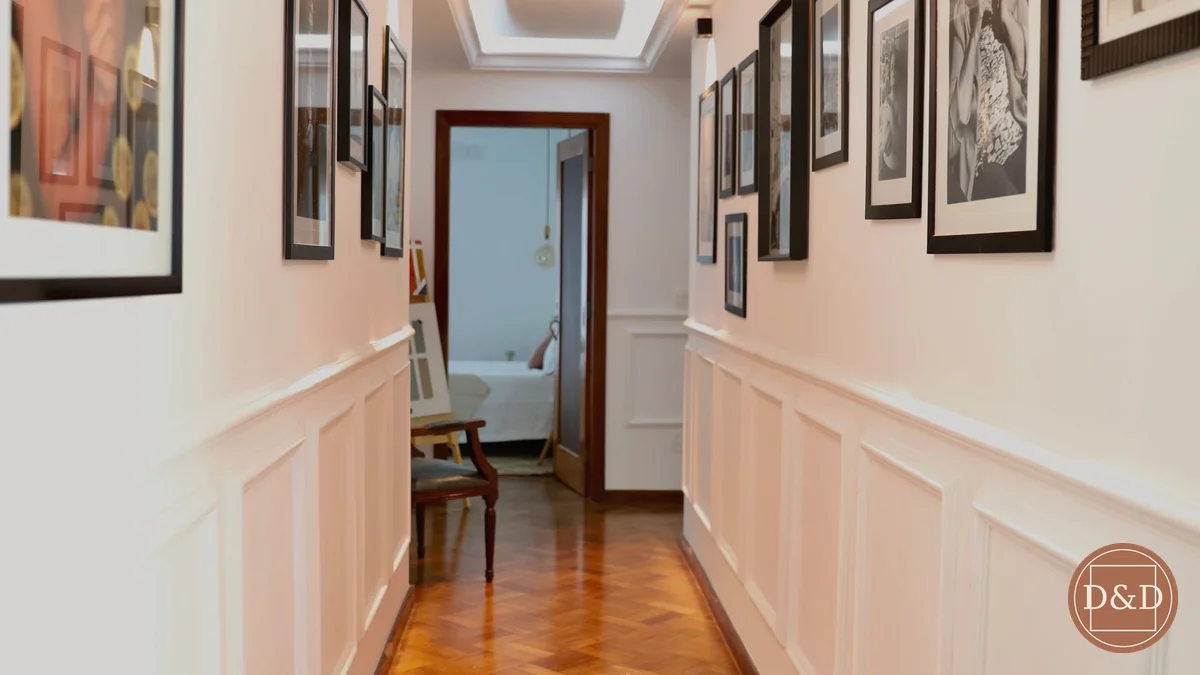
- 8. Build a thrifted gallery wall — $30
- 9. Add peel-and-stick wallpaper to one wall — $45
- 10. Mount a picture ledge instead of hanging frames — $20
- The Floor: One Runner Changes Everything
- 11. Lay a runner that actually fits — $50
- Slim Storage & Furniture (Without Blocking the Path)
- 12. Add a console table no deeper than 12 inches — $60
- 13. Mount a row of wall hooks — $15
- 14. Float one shelf for the "landing strip" — $20
- The Finishing Touch
- 15. End the hallway with life and scent — $15
- What Will This Actually Cost?
- 5 Mistakes That Make Hallways Feel Like Tunnels
- Frequently Asked Questions
- What color makes a hallway look wider?
- How high should hallway art be hung?
- Are mirrors good for narrow hallways?
- What is the best lighting for hallways?
- Can you put wallpaper in a narrow hallway?
- How do you decorate a very narrow hallway?
A narrow hallway is the most neglected space in most homes — a dark tunnel you rush through, not a room you enjoy. But with the right budget moves, that corridor can feel twice as wide, brighter, and genuinely beautiful. These 15 small hallway decor ideas on a budget cost $15 to $60 each, need no renovation, and most are renter-friendly.
The core trick is simple: hallways feel narrow because of visual length. Everything below — paint tricks, mirrors, lighting rhythm, slim furniture — works by breaking up that endless straight line. Pick three or four ideas, spend a weekend, and your hallway stops being a tunnel.
Quick Facts
| Detail | What to know |
|---|---|
| Budget per idea | $15–$60 |
| Full hallway refresh | $45–$290 depending on tier |
| Skill level | Beginner — no power tools needed for most ideas |
| Renter-friendly | 11 of 15 ideas (marked below) |
| Time | One idea: 30–60 min. Full refresh: one weekend |
All 15 Small Hallway Decor Ideas on a Budget at a Glance
| Idea | Typical cost | Time | Renter-friendly |
|---|---|---|---|
| 1. Same-color walls & ceiling | $35 | Half day | With repaint |
| 2. Two-tone paint trick | $45 | Half day | With repaint |
| 3. Dark end wall | $20 | 1 hour | With repaint |
| 4. Painted floor runner | $25 | 2 hours | No |
| 5. Large end mirror | $60 | 30 min | Yes |
| 6. Fixtures every 8–10 ft | $20 each | 20 min each | Yes (plug-in) |
| 7. LED strip wash | $15 | 20 min | Yes |
| 8. Thrifted gallery wall | $30 | 1 hour | Yes |
| 9. Peel-and-stick wallpaper | $45 | 2 hours | Yes |
| 10. Picture ledge | $20 | 30 min | Yes |
| 11. Fitted runner rug | $50 | 10 min | Yes |
| 12. Slim console (≤12″ deep) | $60 | 30 min | Yes |
| 13. Row of wall hooks | $15 | 20 min | Yes |
| 14. Floating landing-strip shelf | $20 | 30 min | Yes |
| 15. Plant + scent at the end | $15 | 10 min | Yes |
Paint & Color Tricks That Visually Widen a Hallway
Color is the highest-impact, lowest-cost hallway tool. Light colors reflect what little light corridors get, while strategic dark accents can actually shorten a tunnel-like space. These four paint ideas cost less than a dinner out.
1. Paint walls and ceiling the same light color —
When walls and ceiling share one light shade (warm white, pale greige), the boundary between them dissolves and the hallway reads as one continuous, airy volume instead of a tight box. One gallon of quality interior paint covers a typical 3×12 ft hallway with two coats for about $35. Renter-friendly: yes, if you repaint before moving out.

2. Try the two-tone trick: darker below, light above —
Painting the lower third (or wainscot height, ~36 inches) a mid-tone and keeping the upper walls light grounds the space without closing it in. The horizontal line draws the eye across the hallway instead of down its length, which makes it feel wider. Two quarts in complementary shades run about $45 total.
3. Paint just the end wall dark to “shorten” the tunnel —
A deep color (charcoal, navy, forest green) on the far end wall visually pulls that wall toward you, so a 20-foot corridor feels like 14. It’s the oldest designer trick for tunnels, and it costs one quart of paint — about $20 — plus an hour. This works best when the side walls stay light for contrast.
4. Paint a faux runner on the floor —
No rug budget? A painted stripe down the center of the floor (or a stenciled border) gives the same path-defining effect as a runner for the price of a quart of floor paint — around $25. Use painter’s tape for crisp edges and keep 6–8 inches of bare floor visible on each side so it reads as intentional, not a mistake. Renter-friendly: only with landlord permission; otherwise skip to idea #11.
Mirrors & Lighting: The Tunnel Breakers
Mirrors double whatever light exists, and rhythmic lighting breaks a hallway’s endless length into welcoming segments. If you do nothing else from this list, do one mirror and fix the lighting — those two moves deliver half the transformation.
5. Hang one large mirror at the end or opposite a doorway —
A mirror at the hallway’s end reflects the room beyond, effectively doubling the perceived depth — or rather, replacing a dead end with a view. Opposite a doorway works too: it borrows light from the adjacent room. A 24×36 inch mirror with a simple frame costs $40–$60 at Target or IKEA. Hang the center at 57–60 inches from the floor, standard gallery height.

6. Add light fixtures every 8–10 feet — each
One lonely ceiling light in a long hallway creates a bright pool surrounded by gloom — that’s what makes corridors feel creepy. Spacing small flush-mount or plug-in wall sconces every 8–10 feet creates an even rhythm of light that shortens the perceived length. Plug-in sconces ($15–$25 each) need no electrician. Renter-friendly: yes with plug-in styles.
7. Run an LED strip along the baseboard or a picture ledge —
A $12–$18 LED strip tucked behind a floating shelf or along the top of the baseboard throws a soft wash of light up the wall, adding depth after dark. Choose 2700K warm white for hallways — cooler temps feel institutional in windowless corridors. Most strips are peel-and-stick and cut to length. Renter-friendly: yes.

Walls That Work Hard
Hallway walls are your gallery, your storage, and your personality — all in a strip 3 feet wide. Treat them as vertical real estate and the floor stays clear.
8. Build a thrifted gallery wall —
A salon-style cluster of frames turns a blank corridor into a destination instead of a pass-through. Thrift stores sell solid frames for $1–$3 each; a 6–8 frame arrangement with free printable art costs about $30 total. Keep the center of the arrangement at 57–60 inches high and leave 2–3 inches between frames. Renter-friendly: yes with adhesive strips.
9. Add peel-and-stick wallpaper to one wall —
Vertical stripes or a subtle geometric pattern draws the eye up, adding perceived height; a bold print on one wall creates a focal point that stops the tunnel feeling. One wall of a standard hallway needs 2–3 rolls at $15–$20 each. Modern peel-and-stick removes cleanly with a hair dryer. Renter-friendly: yes.
10. Mount a picture ledge instead of hanging frames —
A 36-inch picture ledge ($15–$25 at IKEA) lets you lean art and swap it seasonally without new nail holes. In a hallway, one ledge at eye level does the work of six hung frames with a fraction of the wall damage. Style it with 3–5 pieces, tallest in the middle. Renter-friendly: yes with proper anchors.
The Floor: One Runner Changes Everything
11. Lay a runner that actually fits —
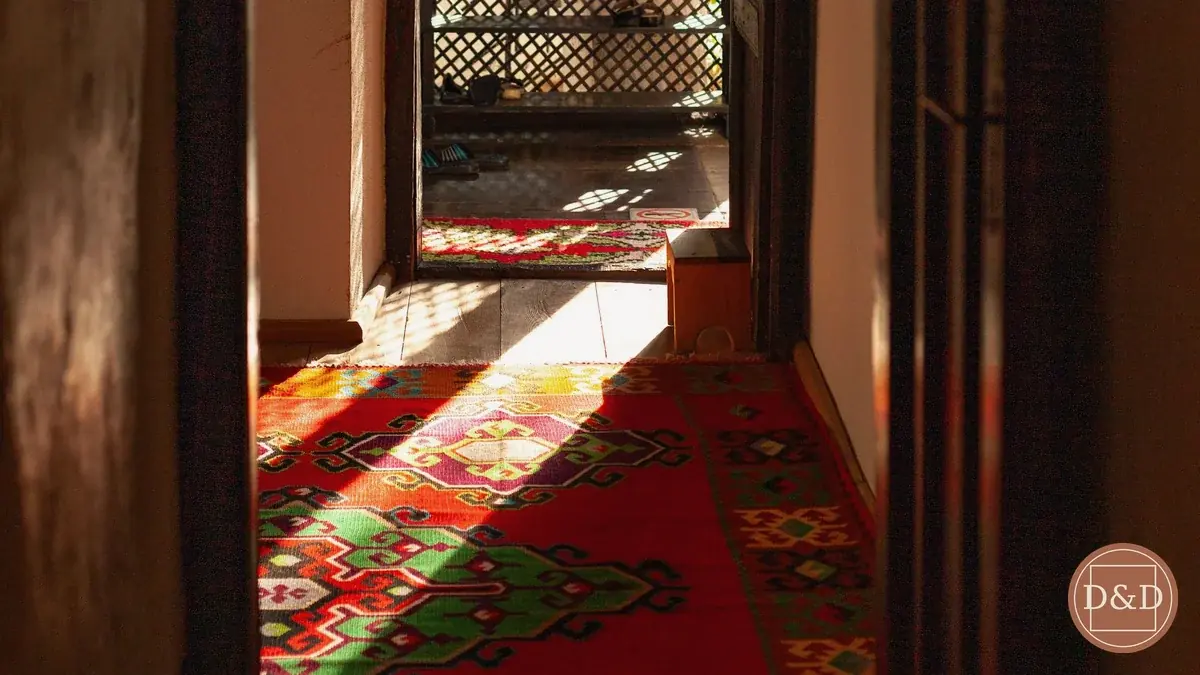
A runner that’s too short chops the hallway into awkward segments; the right one makes it feel intentional and longer in a good way. Measure first: leave 2–3 inches of bare floor on each side and 4–6 inches at each end. A 2.5×10 ft washable runner costs $40–$60. Low-pile or flatweave is essential — anything thicker becomes a trip hazard in a 3-foot-wide space. Renter-friendly: yes.
Slim Storage & Furniture (Without Blocking the Path)
Hallway furniture must earn its footprint: if it sticks out more than 12 inches, it obstructs traffic in a standard 36-inch-wide corridor. Everything here stays slim.
12. Add a console table no deeper than 12 inches —
A 10–12 inch deep console gives you a drop zone for keys and mail plus a styling surface, without eating the walkway. Secondhand consoles are $30–$60 on Facebook Marketplace; new narrow ones run $50–$80 at IKEA or Target. Anchor it to the wall (anti-tip hardware, $5) — hallways get bumped. Renter-friendly: yes with adhesive anti-tip straps.
13. Mount a row of wall hooks —
Five matte-black or brass hooks ($12–$18 for a set) on a hallway wall create a mini mudroom for coats, bags, and dog leashes. Mount at 60 inches high for adults, or add a second lower row at 40 inches for kids. This is the single best storage-per-dollar move for hallways. Renter-friendly: yes with heavy-duty adhesive hooks.
14. Float one shelf for the “landing strip” —
A single 24-inch floating shelf ($15–$25) near the hallway entrance holds a tray for keys, sunglasses, and mail — the classic landing strip, just vertical. Keep it at 48–54 inches high so it’s reachable but above hip-bump height. Pair with a small basket underneath for shoes. Renter-friendly: yes with proper anchors.
The Finishing Touch
15. End the hallway with life and scent —
Whatever sits at the hallway’s end becomes its focal point — make it deliberate. A $8 pothos in a $5 basket plus a $5 reed diffuser turns a dead end into a vignette. If there’s zero natural light, use a high-quality faux plant; in a windowless corridor nobody can tell past three feet. Renter-friendly: yes.
What Will This Actually Cost?
You don’t need all 15 ideas — pick one tier and stop. Each total below adds up the real prices from the ideas above.
- The $45 Refresh: Wall hooks (Idea #13, $15), an LED strip (Idea #7, $15), and a plant with diffuser (Idea #15, $15). Roughly $45 total.
- The $140 Makeover: A large mirror (Idea #5, $60), a fitted runner (Idea #11, $50), and a thrifted gallery wall (Idea #8, $30). Roughly $140 total.
- The $290 Transformation: Full paint refresh (Idea #1, $35), peel-and-stick wallpaper accent (Idea #9, $45), the mirror (Idea #5, $60), runner (Idea #11, $50), slim console (Idea #12, $60), and two plug-in sconces (Idea #6, $40). Roughly $290 total.
5 Mistakes That Make Hallways Feel Like Tunnels
Even good small hallway decor ideas on a budget fail when these mistakes creep in. Avoid all five:
- One sad ceiling light. A single fixture in a long corridor creates the interrogation-room effect. Light every 8–10 feet instead.
- Furniture deeper than 12 inches. A 16-inch dresser in a 36-inch hallway leaves 20 inches to walk through — that’s a shoulder-brusher, not a walkway.
- A too-short runner. A 6-foot rug floating in a 14-foot hallway chops the space visually. Measure and size it right (Idea #11).
- Dark colors on all four surfaces. One dark end wall is a trick; dark everywhere is a cave. Keep three surfaces light.
- Nothing at the end. An empty dead-end wall is where the “tunnel” feeling lives. Always give the eye somewhere to land (Idea #15).
Frequently Asked Questions
What color makes a hallway look wider?
Light, warm neutrals — warm white, pale greige, soft beige. They reflect the limited light hallways get and blur the wall-ceiling boundary. Painting walls and ceiling the same shade (Idea #1) amplifies the effect. Avoid cool grays in windowless hallways; they read as dingy rather than spacious.
How high should hallway art be hung?
Center artwork at 57–60 inches from the floor — standard gallery height, which matches average eye level. In narrow hallways this matters more than in rooms, because viewers stand close; art hung too high forces an uncomfortable upward gaze in a tight space.
Are mirrors good for narrow hallways?
Yes — mirrors are the single most effective hallway widener. Placed at the end of the corridor or opposite a doorway, a mirror reflects light and the adjacent room, visually doubling the space. One large mirror beats several small ones, which can feel cluttered.
What is the best lighting for hallways?
Layered, even lighting: fixtures spaced every 8–10 feet so there are no dark gaps. In windowless hallways use 2700K warm-white bulbs — cooler temperatures feel institutional in corridors. Plug-in wall sconces are the renter-friendly way to add layers without an electrician.
Can you put wallpaper in a narrow hallway?
Yes, with the right pattern. Vertical stripes and small geometrics add perceived height without closing the space in. Limit bold prints to one wall as an accent; papering all four walls of a narrow corridor in a large-scale print will feel busy. Peel-and-stick versions are renter-safe.
How do you decorate a very narrow hallway?
These small hallway decor ideas on a budget go vertical and keep the floor clear: paint tricks for width (Ideas #1–3), one mirror, lighting every 8–10 feet, and nothing deeper than 12 inches on the floor. A hallway under 3 feet wide should have zero floor furniture — walls do all the work.
FTC Disclosure: This article contains no sponsored content and no affiliate links. Prices reflect typical US retail estimates and vary by store and region.
Related: if your hallway connects to your entrance, see also our budget entryway ideas for small foyers — the two spaces should feel like one continuous welcome.
Related: Before picking up a gallon for a two-tone hallway paint refresh, check how much paint you actually need with our paint calculator. For narrow utility corridors nearby, see our 17 small laundry room decor ideas.

Evelyn Marlowe is a home decor writer and small-space devotee covering budget-friendly decorating, rental-friendly upgrades, and seasonal styling — always with real prices and practical advice. Her rule: beautiful homes should be livable, not just photographable.
Related Stories
How to Hang Curtains Without Drilling: 5 Renter Hacks Tested (Up to 25 lbs)
How to Cover a “Boob Light” in a Rental: 5 Under-$35 Fixes (No Wiring)